Part 1: The Enclosure of Bishop Cemetery
St. John the Baptist Parish, Louisiana
This deep study of the cemeteries along the industrial corridor of the southern Mississippi is part of a larger project examining the ways in which commoning creates landscapes, and they ways in which these practices and places are activated as tools against enclosure by forces of capital.
Please see the work of Forensic Architecture as well as Kate Orff’s “Petrochemical America” for more information on this area, and to reference the literature that informs this project.
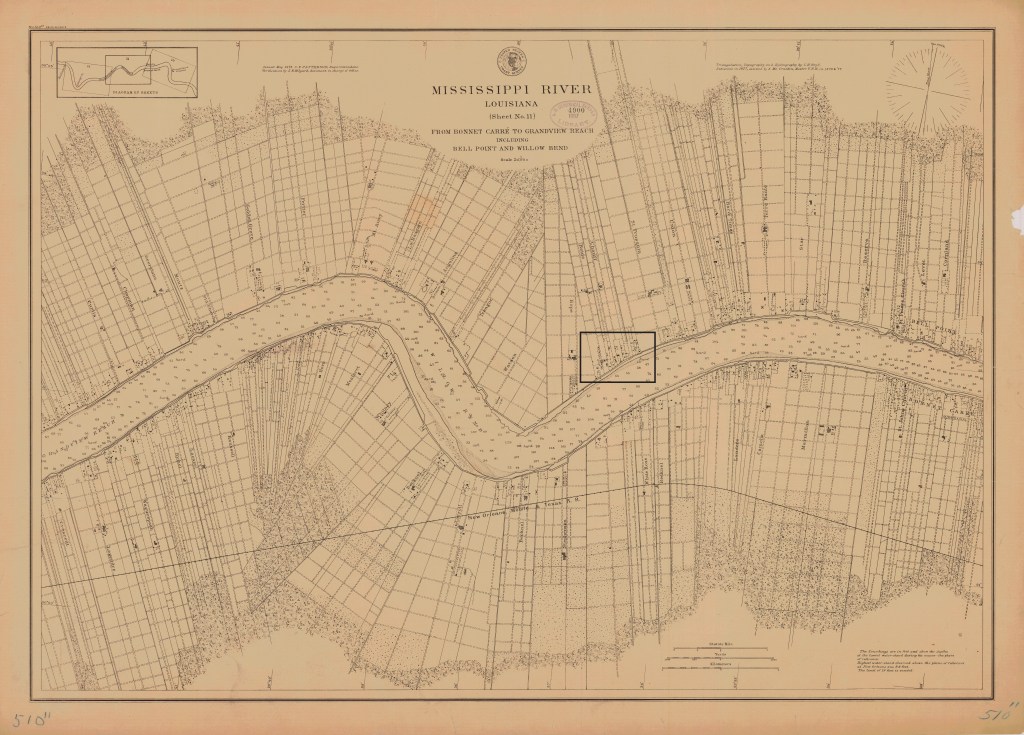
The 1887 coastal survey of St. John the Baptist Parish shows a collection of buildings at the river end of the arpents of the Reine and Chauff plantations. This collection would go on to become the small town of Lions, which has since been absorbed by the Marathon Garyville Refinery, one of many on the southern Mississippi industrial corridor.
The cemetery that corresponded with Lions can be seen in aerial imagery beginning in 1952, though it may have been in use much earlier. Cemeteries cannot legally be disturbed in the state of Louisiana, and so the refinery has grown up around the small tract of land, literally enclosing it and cutting it off from access.

Part 2: Property Dynamics around the Celestin Cemetery

The story of Bishop Cemetery is repeated at the La Pice/Celestin Cemetery. Located on what was plantation land in 1877, the cemetery now sits at the back of a neighborhood that is a small strip of human habitation surrounded by ammonia storage silos and a train yard. The patterns of enclosure being observed in these parishes hearkens back to the19th century English Enclosure Acts, which served to end common land systems, thus forcing the peasantry out of subsistence and agrarian lifestyles and into urban, industrial-based livelihoods and labor.
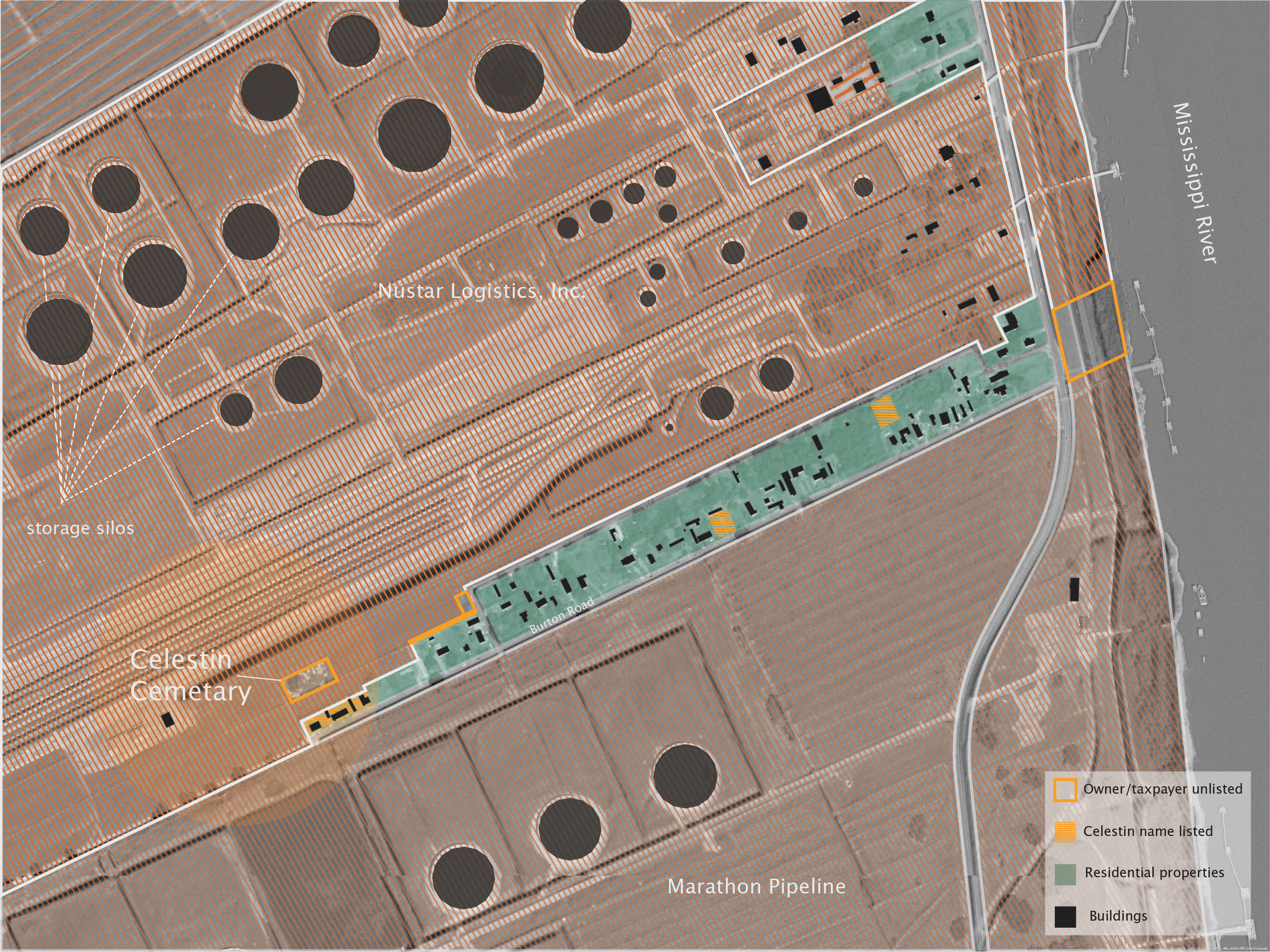

Graphics developed by M. McCahan, illustrating the enclosure of residential spaces by industrialized landscapes.
A similar phenomenon is occurring in the landscapes of the contemporary U.S., to the detriment of ecological and human health. This project seeks to find the ways people are resisting enclosure, undoing its violence, and how this resistance manifests in the landscape.
 Molly McCahan